📖 Pricing study
PickWin Sportsbook — What 640 Priced Markets Revealed
Casino reviews are everywhere; sportsbook reviews that actually check the prices are not. Over six weeks we recorded 640 markets across eleven sports on the PickWin sportsbook, calculated the margin built into each one, counted how deep the book goes on a given fixture and tested cash-out on every in-play bet we placed. What follows is the arithmetic, not the marketing. Figures as of August 11, 2026.
📉
Margin — The Only Number That Decides Value
Every price a bookmaker offers contains a built-in commission called the margin, or overround. Convert each outcome's decimal odds into an implied probability, add them up, and the amount by which the total exceeds 100% is what the book keeps. A two-way market at 2.00 and 2.00 sums to exactly 100% and is a fair coin; the same market at 1.91 and 1.91 sums to 104.7%, and that 4.7% is your long-run cost of doing business.
Across our full sample the PickWin sportsbook averaged 4.1%. That is a genuinely good number — the mainstream industry sits nearer 5.5%, and the gap compounds. A bettor turning over $20,000 a year loses roughly $820 to a 4.1% book against about $1,100 to a 5.5% one, before any handicapping skill enters the picture.
The average hides a spread worth knowing. Top-tier football 1X2 and NHL moneylines were sharpest at 2.9%, which is close to what dedicated low-margin bookmakers offer. NBA spreads ran 3.4%, MLB run lines 3.8%, NFL and CFL spreads 3.6%. Then it widens: eSports match winners 4.7%, tennis outrights 5.4%, MMA 5.9%, football player props 6.1%. Lower-division football reached 7.8%, which is expensive by any standard. The lesson is blunt — stay on the headline markets and the price is excellent; wander into the third tier of a small league and you are paying nearly three times as much for the same bet.
🧩
Market Depth and the Bet Builder
Depth is where PickWin surprised us. A Champions League or headline NHL fixture carried up to 2,400 individual markets: not just the usual totals and handicaps but shots on goal, corners by half, cards by player, period-specific outcomes and a full same-game combination engine. A mid-table domestic match had 300 to 600, which is still comfortable, and even small competitions kept the core dozen.
In-play narrows considerably. The book runs roughly 120 live markets during a match, concentrated on next goal, next scorer, current period and the main totals. Odds refreshed in a median 1.4 seconds during our tests, with occasional 4-second stalls in the last minutes of a close match — normal behaviour when the risk engine is recalculating quickly.
The bet builder handles up to eight legs from a single fixture and prices correlated selections properly, which many books do badly. Its limitation is significant though: builder selections cannot be cashed out. If you value the ability to close a position early, construct the accumulator manually from separate markets instead — you lose the correlation pricing but keep the exit.
💵
Cash-Out — Available, Useful, Not Free
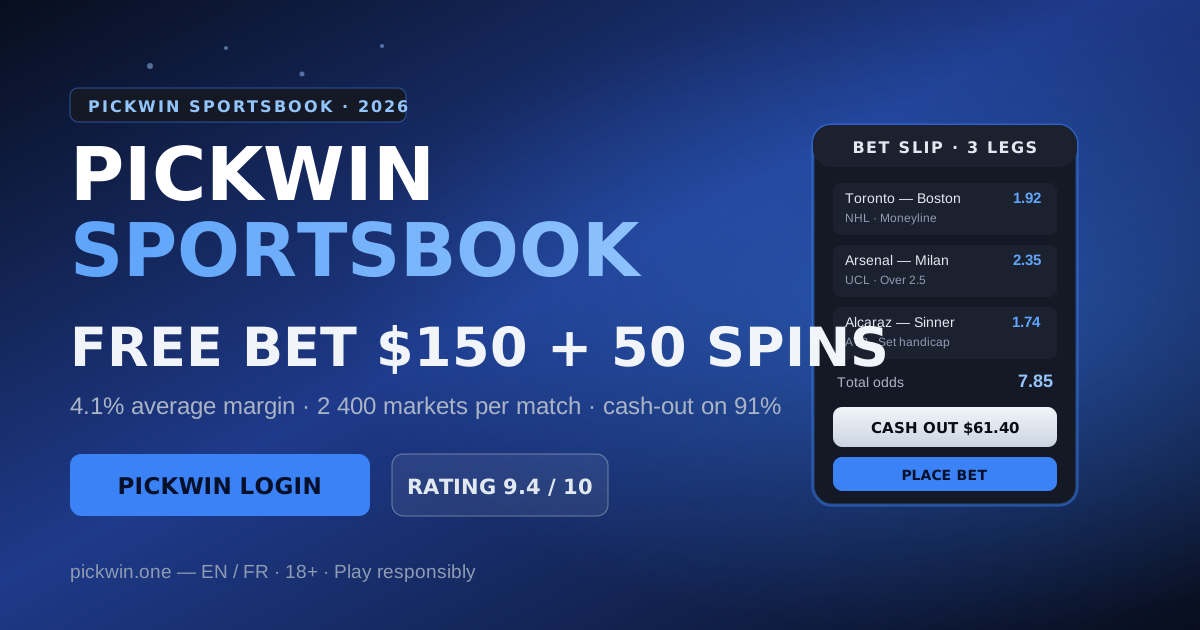
Cash-out was offered on 91% of the in-play bets we settled, in full or partial form, with partial cash-out letting you bank a portion and leave the rest running. That coverage is high; many sportsbooks sit nearer 70%, and the gaps are usually the markets you most want to exit.
What matters is the price of the exit. Cash-out is recalculated from live odds with an operator margin layered on top, and across our sample that layer ran 5 to 8% below fair value. That is standard rather than predatory, but it means cash-out is a risk-management tool, not a profit strategy — taking it systematically costs you money over time. Use it when circumstances change, not as a habit.
The auto cash-out rule, which triggers automatically at a chosen value, worked reliably in our tests including during fast-moving sequences. Bet builder selections remain excluded, and cash-out is suspended during goal reviews and video checks, which is correct behaviour rather than a fault.
🎁
The Free Bet Offer, Read Properly
New sportsbook players get a matched free bet up to $150 plus 50 casino spins. The qualifying wager must be at odds of 1.80 or longer, and the free bet is credited once it settles, win or lose. It carries a 6× rollover at the same minimum odds and expires after 14 days.
Two details decide what it is really worth. First, the stake is not returned on free bet winnings: a $150 free bet at 2.00 pays $150, not $300. Second, the 6× rollover applies to the free bet amount rather than to any winnings from it. Working through the arithmetic, a $150 matched free bet at typical odds is worth roughly $95 to $110 in expected value — a good offer, considerably better than a casino bonus at 40× wagering, but not the flat $150 the banner implies.
💡 How to read a cash-out offer
Fair value$66What the position is worth at live odds with no margin applied.
PickWin offer$61.40Roughly 7% below fair — standard across the industry, not a red flag.
Cost of habit−5–8%Every routine cash-out pays that gap. Use it for changed circumstances, not comfort.
📡
In-Play Betting and the Streaming Question
Live betting is where sportsbooks either feel responsive or feel broken, and PickWin lands firmly on the right side. Odds refreshed in a median 1.4 seconds, the bet slip accepted price movement with a clear accept-changes toggle rather than silently rejecting the slip, and settlement on the in-play bets we placed arrived within 40 seconds of the event resolving. Nothing hung, nothing needed a support ticket.
The gap is video. There is no integrated live streaming, so you are watching elsewhere and betting here, which introduces a delay of several seconds between what you see and what the book has already priced. On fast markets — next goal, next point — that delay is a real disadvantage and the reason we would not chase in-play prices on a broadcast delay. Statistical trackers and live match visualisations are provided instead, and they update fast enough to be useful, but they are not a substitute for pictures.
Where the in-play engine shines is the settlement of derived markets. Shots, corners and cards settled from official feeds within a minute of full time, including on the mid-tier competitions where slower books often leave bets pending overnight. For a bettor whose staking plan depends on funds recycling quickly, that reliability matters more than a flashy interface.
🔑
One PickWin Login for Both Halves
The sportsbook and casino are the same account, the same wallet and the same pickwin login. Switching between them requires no re-authentication, a sports withdrawal draws from the same balance as a slot session, and the bonus history shows both in one list. That sounds obvious and is not: plenty of operators still run two products on two logins with a manual transfer between them.
Odds display in decimal by default with American and fractional formats in settings — worth switching deliberately, because decimal is the only format in which margin is quick to calculate mentally. Bet history, open positions and settled slips sit in one area, exportable as a CSV, which is unusual and genuinely useful if you track results seriously.
Pickwin fun mode belongs to the casino side rather than the sportsbook: every slot, crash game and RNG table opens free with virtual credits and no account. There is no demo betting because odds settle against real fixtures, but the entire market list and all prices are browsable without registering, which is the sportsbook equivalent and lets you verify our margin figures yourself before depositing anything.
⚖️
Limits, Restrictions and the Honest Caveats
Maximum stakes scale by market: up to $50,000 on a top-tier football 1X2, around $12,000 on NHL moneylines, and as little as $400 on obscure player props. Maximum payout per slip is capped at $500,000. Those are healthy numbers for all but professional stakes.
The question every serious bettor asks is whether winning accounts get limited. In our six-week window, betting modest amounts, we saw no restriction — but six weeks and modest stakes prove nothing about how the risk desk treats a consistent winner over a year, and any book reserves the right to reduce limits. Assume it can happen, as at every bookmaker that is not explicitly a low-margin exchange.
The structural caveat is the licence. PickWin operates internationally rather than under a national regulator, so a disputed settlement goes to an independent adjudicator rather than to a body with statutory powers. That is what keeps our score at 9.4 rather than higher, because on pure pricing and product this is one of the strongest sportsbooks we have measured. Bet the headline markets, use decimal odds, treat cash-out as insurance rather than strategy, and PickWin gives you an unusually fair price.
▸ Sportsbook strengths
- 4.1% average margin against a 5.5% industry norm
- 2.9% on top football and NHL — near low-margin territory
- Up to 2,400 markets on a headline fixture
- Cash-out on 91% of in-play bets, partial supported
- One pickwin login and one wallet for sport and casino
- Bet history exportable as CSV
▸ Sportsbook weaknesses
- 7.8% margin in lower divisions — avoid them
- Bet builder selections cannot be cashed out
- In-play depth drops to about 120 markets
- Free bet stake not returned on winnings
- International licence, adjudicator not a regulator